
From drum loop to drum performance
A drum loop is not a drum track.
A loop can be a great starting point. It gives you a groove, a feel, and something to write against. But if you copy the same two bars across an entire song, the listener will eventually notice.
Or worse, they won’t notice anything at all because the track never changes.
A real drummer reacts to the song. They play differently in the verse, chorus, bridge, intro, outro, and breakdown. They add small variations. They leave space. They build energy. They set up transitions.
That’s what this post is about: turning MIDI drum loops into full, believable drum arrangements.
No drummer required, but we do need to borrow a little drummer logic.
Start with the song
Before editing MIDI drums, listen to the song.
Ask yourself:
- What is the tempo?
- What is the main feel?
- Should the drums push forward or sit back?
- Where does the song need energy?
- Where does it need space?
- What is the bass doing?
- What should happen when the chorus arrives?
Drums are not just a rhythm grid. They shape the emotional movement of a track.
A good drum arrangement supports the song. A bad one competes with it. A really bad one sounds like someone kicked a toolbox down a staircase and then added reverb.
Think like a drummer
This is the most important rule in MIDI drum arrangement:
A real drummer has two hands and two feet.
Unless you are writing for an octopus, your MIDI parts should respect that.
For example, if a drummer hits a crash cymbal with the right hand, that same hand probably cannot also play the hi-hat at the exact same moment.
A common beginner mistake is stacking:
- Crash
- Hi-hat
- Snare
- Ride
all at once.
It might look powerful in the piano roll, but it can sound unnatural because no real drummer could comfortably play it.
When adding a crash, remove the hi-hat or ride note that the same hand would have played. When writing a tom fill, reduce or remove the hi-hat pattern. When switching to the ride, let the hi-hat drop out or become a foot chick.
This one habit can make your MIDI drum parts sound much more believable.
Build sections, not just patterns
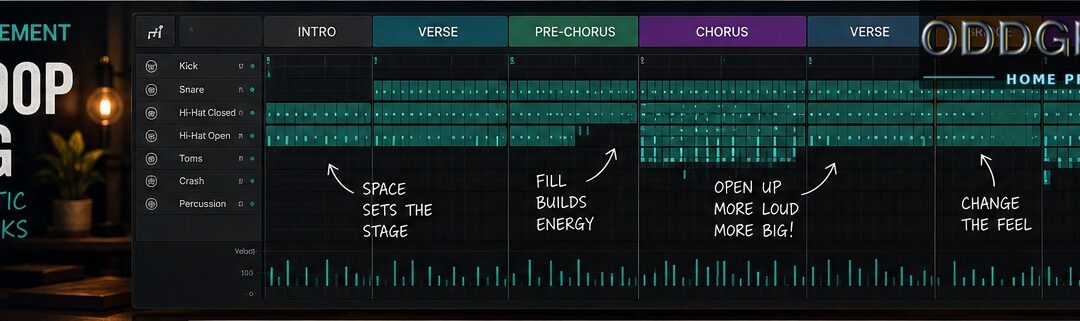
A song usually needs different drum parts for different sections.
Think in terms of energy.
Intro
The intro might not need a full groove.
You could use:
- Kick only
- Hi-hat only
- Toms
- A light version of the main groove
- Cymbal swells
- No drums at all
Do not be afraid of making the drums wait. When they enter, it matters more.
Verse
The verse often needs space.
Try:
- Closed hi-hats
- Lighter snare hits
- Fewer crashes
- Simpler kick patterns
- More room for the vocal or lead instrument
A good verse groove supports the song without announcing, “Look at me, I own three ride cymbals.”
Pre-chorus
The pre-chorus usually builds energy.
You can add lift by:
- Opening the hi-hat slightly
- Increasing velocity
- Adding snare pickups
- Making the kick pattern more active
- Using a small fill into the chorus
- Moving from tight hats to a wider cymbal texture
The pre-chorus should feel like it is going somewhere.
Chorus
The chorus often needs more weight and width.
Try:
- Stronger snare backbeats
- Crash cymbal on the downbeat
- Ride or open hi-hat
- Slightly busier kick pattern
- More room mic or ambience
- Stronger velocities
The chorus should usually feel bigger than the verse. Not always louder in a crude way, but more open, more confident, and more energetic.
Bridge
The bridge is a chance to change texture.
You could try:
- Half-time feel
- Toms
- Sidestick
- Ride bell
- Sparse kick and snare
- Percussion
- A stripped-down groove
The bridge should give the listener a new angle before returning to the main idea.
Outro
The outro can either build or simplify.
A drummer might add extra fills, open the hats, move to the ride, or strip things back depending on the song.
The key is intention. Don’t just let the loop run until the song ends and everyone quietly leaves.
Make hi-hats feel human
Hi-hats are one of the biggest giveaways in programmed drums.
The classic stiff MIDI pattern is eight identical closed hi-hat hits per bar, all perfectly quantized, all at the same velocity.
That is technically a groove. It is also emotionally similar to a printer test page.
A real drummer plays hi-hats with subtle changes in dynamics and articulation.
For a basic eighth-note pattern, try accenting the downbeats and softening the offbeats:
1 and 2 and 3 and 4 and
A simple velocity pattern might look like:
Strong, soft, strong, soft, strong, soft, strong, soft
For example:
- Downbeats: velocity 85 to 105
- Offbeats: velocity 50 to 75
- Strong accents: velocity 100 to 115
- Occasional softer notes: velocity 40 to 60
You can also vary the articulation:
- Closed tip for softer notes
- Closed edge for accents
- Slightly open hat before a chorus
- Open hat at the end of a phrase
- Foot chick where the hand leaves the hi-hat
Small variations go a long way.
Do not randomize everything wildly. Human feel is not chaos. It is controlled imperfection.
Use ghost notes carefully
Ghost notes are quiet snare hits played between the main backbeats.
They can make a groove feel more alive, especially in funk, soul, R&B, blues, progressive rock, and anything with a deeper pocket.
A typical snare backbeat might sit around velocity 95 to 120.
Ghost notes might sit around velocity 20 to 50.
That difference is important. Ghost notes should support the groove without drawing attention to themselves.
If your ghost notes are as loud as your backbeat, they are not ghost notes anymore. They are regular notes wearing a sheet and hoping nobody notices.
Use ghost notes to add motion, but leave space. Too many ghost notes can make the drummer sound nervous.
Write fills that lead somewhere
A fill is not just a chance to show off.
A fill is a transition.
It should help move the song from one section to another.
Good fills answer questions like:
- Are we entering a chorus?
- Are we leaving a verse?
- Are we setting up a stop?
- Are we building tension?
- Are we changing feel?
- Are we surprising the listener?
Simple fills often work best.
Try:
- A snare pickup before the chorus
- A short tom fill at the end of a verse
- A kick and snare push before a downbeat
- A cymbal crash on the first beat of a new section
- A one-beat pause before a big entrance
Also, remember drummer anatomy.
If the drummer is playing a tom fill with both hands, the hi-hat probably stops. If a hand moves to a crash cymbal, it cannot keep playing the ride at the same time.
Fills should sound playable, not like a drum kit being pushed out of a van.
Should you quantize MIDI drums?
Yes possibly, but carefully if you do.
Quantization moves MIDI notes to a rhythmic grid. It can tighten a performance, but it can also kill the groove if overused.
Perfect timing is not always better timing.
Try these approaches:
- Quantize only the kick and snare
- Use partial quantization, such as 50 percent strength
- Leave hi-hats slightly looser
- Keep fills less perfect
- Use groove quantization instead of straight grid quantization
- Fix only the notes that sound wrong
The piano roll can be misleading. A note may look late but feel great. Another note may look perfect but sound stiff.
Always listen in context with the bass and other instruments.
The grid is a tool. It is not the drummer.
Use groove templates
A groove template lets you apply the timing feel of one performance to another.
For example, you can take the timing from a live drum groove and apply it to a programmed MIDI part.
This can help preserve the subtle push and pull that makes a groove feel human.
Groove templates are especially useful when different instruments need to share the same rhythmic feel. Bass, rhythm guitar, keys, and drums should sound like they are in the same band, not like they met five minutes before the session.
Use groove templates carefully. Too much groove processing can feel artificial too.
A little goes a long way.
Understand swing
Swing changes the timing between notes.
In straight eighth notes, the notes are evenly spaced.
In swung eighth notes, the offbeats are delayed, creating a triplet-like feel.
Swing can make a groove feel:
- More relaxed
- More funky
- More bluesy
- More old-school
- More human
But too much swing can make the track wobble.
Adjust swing while the full song is playing. The right amount depends on the music, not the number on the screen.
Use MIDI grooves as raw material
Ready-made MIDI grooves can be extremely useful.
A good MIDI library gives you real-feeling performances, fills, dynamics, and variations. This is especially helpful if you are not a drummer.
But don’t just drag in a loop and call it done.
Edit it for the song.
Try changing:
- Kick pattern
- Snare ghost notes
- Hi-hat openness
- Ride or crash choices
- Fills
- Velocities
- Section variations
A MIDI groove library is not cheating. It is a starting point.
Think of it as working with a drummer who gave you a take. You still get to produce it.
Make loops come alive
To make a MIDI drum loop feel alive, add small changes every few bars.
For example:
- Remove one kick before a new section
- Add a ghost note
- Open the hi-hat slightly
- Change the final bar of a four-bar phrase
- Add a small fill every eight bars
- Move from hi-hat to ride in the chorus
- Add a crash only on important downbeats
- Simplify the groove under vocals
The goal is not constant change. The goal is natural movement.
Real drummers repeat themselves, but not like a copy-paste command with self-esteem issues.
Common MIDI arrangement mistakes
Repeating the same loop for the whole song
Even a great loop gets boring if nothing changes.
Create section variations.
Too many crashes
Crashes are punctuation. Not every sentence needs five exclamation marks.
Use crashes to mark important moments.
Impossible parts
Always check whether a real drummer could play the part.
If one hand is playing crash, ride, hi-hat, and toms at once, simplify.
Fills that are too busy
A fill should lead into the next section. It should not explain the drummer’s entire personality.
Simple often sounds more professional.
No dynamics between sections
The chorus should usually feel different from the verse.
Use velocity, cymbal choice, drum density, and ambience to create contrast.
FAQ: MIDI drum arrangement
How do I arrange MIDI drums for a full song?
Arrange MIDI drums by creating different parts for each song section. Use simpler grooves in verses, more energy in choruses, fills for transitions, and small variations every few bars.
How do I make MIDI drum loops sound less repetitive?
Make MIDI loops less repetitive by changing velocities, adding small fills, altering hi-hat articulations, removing or adding kick hits, and creating section-specific variations.
Should hi-hats be the same velocity?
No. Real hi-hat playing usually has accents and softer in-between hits. Varying hi-hat velocity is one of the easiest ways to make MIDI drums sound more human.
What are ghost notes in MIDI drums?
Ghost notes are quiet snare hits played between main snare backbeats. They add feel and motion to a groove, but they should be much softer than the main snare hits.
How much should I quantize MIDI drums?
Quantize only as much as needed. Try partial quantization or groove templates instead of snapping every note perfectly to the grid. Keep the feel musical.
What is a groove template?
A groove template captures the timing feel of one performance and applies it to another. It can help programmed MIDI parts feel more natural and connected.
How do I write better drum fills?
Write drum fills that lead into the next section. Keep them playable, avoid unnecessary complexity, and remove hi-hat or ride notes when the drummer’s hands move to toms or crashes.
Are MIDI drum grooves good for real songs?
Yes. Professionally played MIDI grooves can work very well in real songs, especially when edited to match the arrangement, bass line, and song dynamics.
Final thoughts
A realistic MIDI drum arrangement is not about filling every empty space.
It is about movement, contrast, and musical logic.
Think like a drummer. Build sections. Vary the hi-hats. Use ghost notes with taste. Write fills that lead somewhere. Don’t quantize the life out of the groove.
And most importantly, make the drums serve the song.
Not the piano roll.
The song.
Up next: How to Produce and Mix MIDI Drums